Exeter’s built environment is a palimpsest of geological ambition—Roman foundations atop the Isca Dumnoniorum, medieval vaults cut into red sandstone, and modern developments pushing east onto the Permian and Carboniferous formations that define the city’s subsurface. A soil mechanics study here has to reconcile this layered history with the physical reality of the Culm Measures mudstones, the Dawlish Sandstone Formation, and the soft alluvial clays along the Exe Estuary. The city’s rapid post-1990 expansion into former agricultural land north of Pinhoe and east of Topsham means many sites now encounter variable drift deposits over bedrock at depths that can shift by several metres across a single plot. We run a full soil mechanics study under BS 5930:2015+A1:2020 and BS EN 1997-2:2007, producing factual and interpretative reports that give structural engineers a defensible basis for foundation selection, whether it’s a piled scheme through compressible estuarine silts near the Quay or a spread footing bearing onto the Breccia. For schemes where ground variability is high, we often combine the soil mechanics study with targeted CPT testing to pin down stratigraphic boundaries between the sandstone and the overlying head deposits without the disturbance that borehole sampling can introduce.
Exeter’s ground doesn’t read textbooks—a soil mechanics study here must interpret the Heavitree Breccia’s unpredictable weathering profile alongside the soft clays of the Exe floodplain.
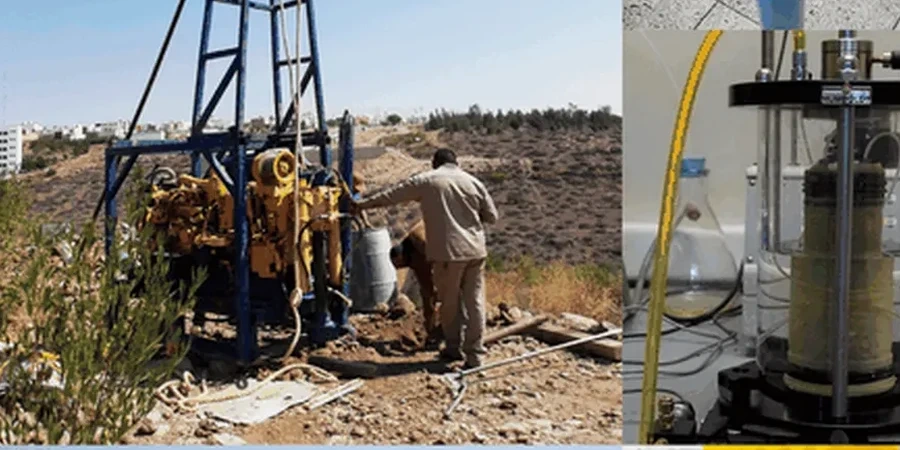
Scope of work in Exeter
Critical ground factors in Exeter
Eurocode 7 requires that the ground model be established with sufficient confidence to select the appropriate Geotechnical Category and partial factors for design—and in Exeter, the consequence of an incomplete ground model is disproportionately high. The city sits within a moderate seismic hazard zone according to the British Geological Survey’s updated probabilistic hazard maps, and the soft clays of the Exe floodplain exhibit a cyclic degradation of undrained shear strength that must be factored into any seismic bearing capacity check. More immediate, however, is the risk of differential settlement where a structure straddles the contact between the Breccia and the alluvial deposits: without a soil mechanics study that maps this transition precisely, you can end up with angular distortion exceeding 1/500, cracking masonry and jamming doors. Our reports flag these interfaces explicitly and provide zoned subgrade reaction modulus values for the structural model. We also assess the potential for pyrite-related heave in the dark mudstones of the Crackington Formation, which outcrop in the north of the city, because sulfate attack on concrete and floor slab uplift have been documented in several Exeter postcodes when the geotechnical investigation skipped a detailed chemical analysis.
Our services
Our soil mechanics study in Exeter is structured around two complementary service packages that cover the full project lifecycle from feasibility through detailed design.
Comprehensive Laboratory Testing Programme
UKAS-accredited testing on undisturbed and disturbed samples recovered from boreholes and trial pits across Exeter. We run classification suites (PSD, Atterberg limits, moisture content, density), strength tests (CIU and CD triaxial, unconfined compression on rock cores from the Breccia), and compressibility testing (oedometer consolidation for settlement prediction). Every parameter is reported with its statistical distribution to support characteristic value selection per Eurocode 7.
Geotechnical Interpretative Reporting
A fully reasoned Designers’ Soil Report that translates laboratory data into a ground model for your structural engineer. We define the bearing stratum, calculate allowable bearing pressures under drained and undrained conditions, provide spring stiffnesses for raft and piled raft analysis, and assess excavation stability. The report includes a parameter selection narrative that justifies every value against the site stratigraphy and the regional geology of the Exeter–Crediton Trough.
Common questions
How much does a soil mechanics study cost for a project in Exeter?
A full soil mechanics study for a typical residential or small commercial development in Exeter falls between £2.830 and £3.820. The final figure depends on the number of boreholes, the depth of investigation required to reach competent ground (which varies considerably between the Breccia outcrops and the Exe alluvium), and the testing schedule—whether you need one oedometer or five, whether triaxial testing runs on three specimens or twelve. We provide a fixed-price proposal after reviewing the desk study and site location.
What makes Exeter's ground conditions different from other UK cities?
Exeter sits on the Permian-Triassic boundary, which means you can encounter the Heavitree Breccia—a cemented, heterogeneous conglomerate—within a few metres of the surface in the city centre, but move south toward the estuary and you are into up to 15 metres of soft, compressible alluvium. The sandstone weathering profile is also highly irregular, with corestones of intact rock floating in a matrix of completely weathered sand. That variability demands a site-specific investigation every time.
Do you need a soil mechanics study for a single house extension in Exeter?
Building Control often requires a ground investigation for extensions where the new foundations will be deeper than the existing ones, or where the property is in an area of known shrink-swell clay or filled ground. Exeter has pockets of made ground across the historic core and along former railway alignments. A targeted investigation with two or three dynamic probe tests and a single laboratory classification suite can satisfy the requirement without excessive cost.
How long does it take to get the laboratory test results and the final report?
Classification tests—moisture content, Atterberg limits, particle size distribution—are typically reported within 5–7 working days of sample receipt. Triaxial and oedometer tests require longer, usually 3–4 weeks, because we have to run the consolidation and shearing stages at the correct in-situ stress levels and allow for pore pressure equalisation. The interpretative report follows within 2 weeks of the final lab data. A complete soil mechanics study from fieldwork to final report generally takes 6–8 weeks for a medium-sized project.
What standards do you follow for soil testing in the UK?
All our laboratory testing is performed to BS 1377:2018 and the relevant parts of ISO 17892, under UKAS accreditation. The field investigation is conducted to BS 5930:2015+A1:2020, and the interpretative report is aligned with the requirements of BS EN 1997-2:2007 for the derivation of geotechnical design parameters. We also reference CIRIA guidance and BGS geological mapping to frame the site within Exeter’s regional ground model.