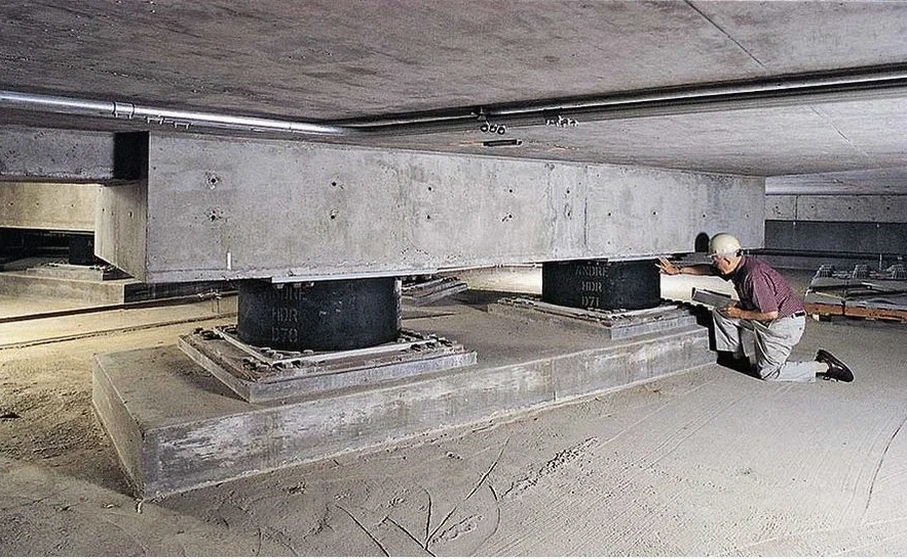
Exeter sits on Permian-age sandstones and breccias, with the Dartmoor granite massif rising just 15 km to the west. While the UK isn't known for large earthquakes, the British Geological Survey records around 300 tremors annually across the country, and the 5.2 ML Market Rasen event in 2008 reminded engineers that even moderate seismicity can expose vulnerabilities in fixed-base structures. For hospitals, data centres, and heritage retrofits in the city centre, base isolation seismic design becomes a practical engineering decision rather than an academic exercise. Our team has worked on projects where the stiff, fractured bedrock of the Exeter Formation transmits high-frequency ground motion efficiently, making isolation bearings particularly effective at decoupling the superstructure from short-period acceleration peaks. We follow BS EN 1998-1 and the UK National Annex, adapting isolation parameters to the low-to-moderate seismicity context that characterises southwest England.
A well-tuned isolation system in Exeter's stiff Permian geology can cut base shear by 70–85%, turning a moderate UK earthquake into a non-event for the structure above.
Scope of work in Exeter
Critical ground factors in Exeter
The isolator testing rig we specify for Exeter projects is a dual-actuator dynamic test machine capable of applying 2,000 kN vertical load while imposing ±300 mm horizontal displacement at velocities up to 800 mm/s — the kind of setup you find in accredited UK laboratories running full-scale prototype tests to BS EN 15129 Annex B. Skipping proper site-specific ground motion selection is the most common shortcut we see, and it backfires badly. Using generic far-field records on a site where the bedrock is fractured and the wave propagation is dominated by high-frequency content leads to underestimating isolator displacements by 20–30%. The other risk that keeps cropping up in southwest England is ignoring the low-temperature stiffening behaviour of elastomeric bearings. Exeter's winter nights can drop below -5°C, and without correct compound formulation the shear modulus can increase enough to shift the isolation period outside the design plateau. Our lab runs low-temperature shear tests to verify the rubber compound remains compliant across the full service temperature range specified in the UK National Annex.
Our services
Base isolation design in Exeter doesn't stop at selecting bearing types and running response-spectrum analyses. Each project brings its own set of constraints — heritage facades that can't tolerate differential movement, floodplain sites with high groundwater, or bedrock depth variability across a single building footprint. The services below cover the two phases that most influence isolation performance: the geotechnical characterisation that feeds the structural model, and the dynamic analysis that validates the isolation strategy.
Geotechnical Investigation for Isolation Design
Before any isolator is sized, we need shear-wave velocity profiles and accurate stratigraphy. We run seismic CPT, downhole MASW, and lab dynamic triaxial tests on undisturbed samples to build the site response model. In Exeter's Permian sandstone, weathering grade varies sharply within metres, so we map the rockhead carefully and provide strain-dependent stiffness degradation curves for the time-history analyses.
Nonlinear Time-History Analysis and Isolator Specification
We model the full isolation layer — HDRB, lead rubber bearings, or sliding pendulum systems — in OpenSees or ETABS using bilinear or Bouc-Wen hysteresis. Ground motions are selected and scaled to match the UK-specific uniform hazard spectrum, and we verify compliance with BS EN 1998-1 drift limits, uplift constraints, and displacement capacity across multiple performance levels including the MCE.
Common questions
Is seismic isolation necessary for a building in Exeter, given the low seismicity?
For most conventional buildings, base isolation isn't required under UK Building Regulations. But for critical infrastructure — hospitals, emergency response centres, data storage facilities, or heritage structures where damage would be unacceptable — Eurocode 8 allows performance-based design that justifies isolation even in low-seismicity regions. The cost-benefit analysis often favours isolation when operational continuity after an earthquake is non-negotiable.
What types of isolators are most suitable for Exeter's ground conditions?
On the stiff Permian sandstone typical of Exeter, high-damping rubber bearings and lead rubber bearings both work well because the high-frequency ground motion is efficiently filtered by the isolation layer. We tend to avoid friction pendulum systems unless the structure is very heavy and the bedrock is exceptionally flat, because the moderate accelerations in the UK may not reliably activate the slider mechanism.
How long does a base isolation design and testing programme take?
From site investigation to final isolator specification, a typical programme runs 8 to 14 weeks. This includes geophysical surveys, lab testing of soil samples, ground motion selection, structural modelling, and prototype isolator testing if required. The timeline stretches when we need to import accelerograms that match the UK's specific spectral shape, which is flatter at short periods than typical Mediterranean records.
What does base isolation seismic design cost for a project in Exeter?
For a complete isolation design package — covering geotechnical input, dynamic analysis, isolator specification, and testing oversight — fees typically fall between £3,410 and £7,310 depending on structural complexity, number of isolators, and whether nonlinear time-history analysis is required. This excludes the isolator hardware and installation, which are priced separately by the bearing manufacturer. More info.