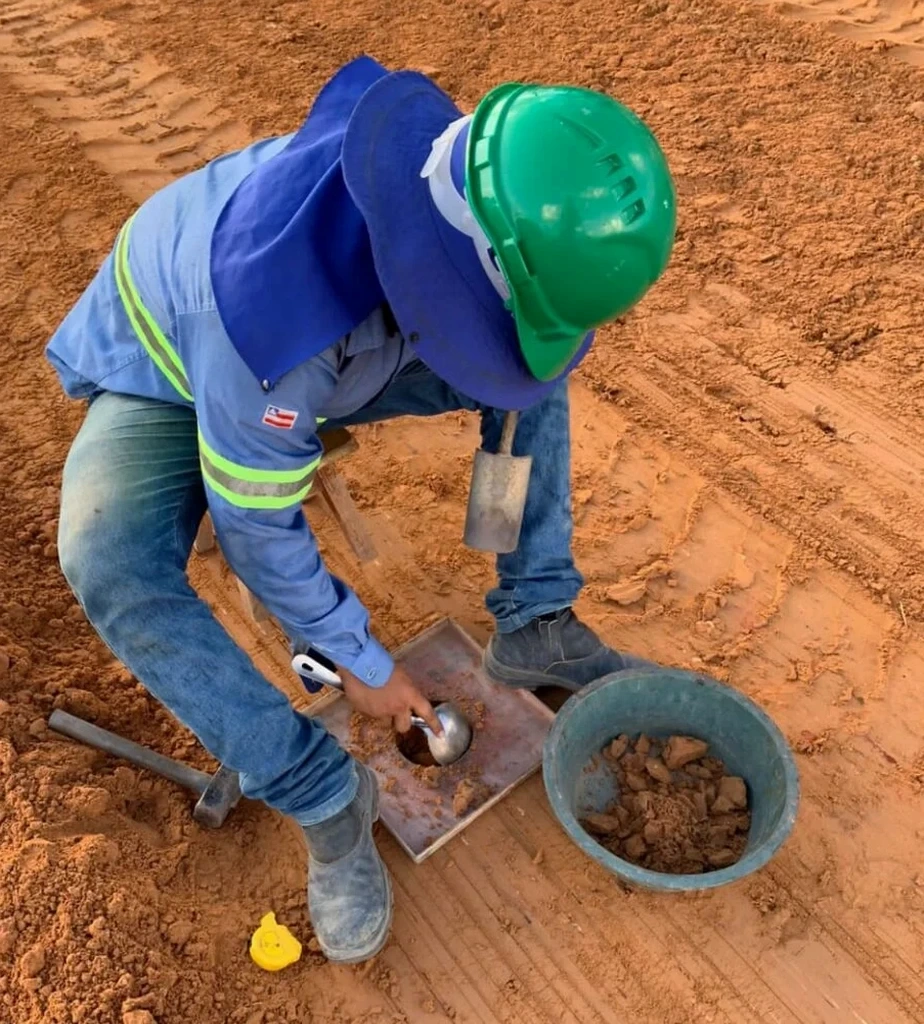
The steel base plate sits flat on the compacted layer, and the technician attaches the sand cone apparatus. In Exeter, where red sandstone weathers rapidly into a silty matrix, getting an accurate field density reading means working quickly. The sand cone method remains the most direct way to verify that compaction has actually been achieved. It is low-tech, yes. But it is brutally honest. The team hauls calibrated Ottawa sand, chisels, and moisture tins onto sites from Marsh Barton trading estates to the steep lanes of St. Leonards. A hole is excavated, the soil bagged, and the volume filled with sand of known density. The math is simple. The implications are not. A single failed test on a subgrade can hold up a Section 278 agreement for days. We run these tests alongside other investigations such as CBR assessments when the pavement design depends on a verified formation level, ensuring the structural section stands up to Devon County Council scrutiny.
You can fool a visual inspection, but the sand cone test exposes every air void in the compacted layer.
Scope of work in Exeter
Critical ground factors in Exeter
Exeter's post-war expansion pushed development onto the steep slopes of the Exe valley, where cut-and-fill operations placed red breccia over softer alluvial clays. The geological map shows thick bands of the Exeter Volcanic Series underlying the northern suburbs, producing highly variable fill. A compaction specification that worked perfectly on a level site in Sowton can fail completely on a terraced plot in Pennsylvania. When fill is placed over a slope, the lower lifts often receive less effective compactive effort due to edge restraint. The sand cone test catches these weak zones before they become settlement problems. We have tested backfill behind retaining walls in the city centre where the specified 95% relative compaction was achieved in the top lift but dropped to 88% just 300 mm below the surface. Without direct density measurement, that defect stays hidden until the pavement cracks. The combination of weathered sandstone, seasonal saturation, and sloping bedrock makes Exeter ground unforgiving to assumptions.
Our services
The sand cone test is one element of a broader earthworks verification package. On Exeter jobs we typically combine it with complementary field and lab methods to give the contractor a complete picture of fill performance.
Nuclear density gauge comparison
We run parallel sand cone and nuclear gauge tests to calibrate the gauge against the direct method, a requirement on many highway earthworks where rapid testing is needed across large footprints.
Laboratory compaction (Proctor) testing
Before field density can be judged, we need the reference maximum dry density. Our lab runs BS 1377-4 vibrating hammer and 2.5 kg rammer Proctor tests on material sampled directly from the borrow pit or site cut.
Moisture conditioning assessment
Exeter's sandstone fill is notoriously moisture-sensitive. We test the as-delivered moisture against optimum and specify aeration or wetting-up procedures before compaction begins, preventing costly re-rolling after a density failure.
Common questions
How much does a sand cone density test cost in Exeter?
A single sand cone field density test on a site within the Exeter area typically runs between £80 and £120, depending on the number of tests in the day's schedule and the travel distance from our base. Mobilisation costs are spread across multiple tests, so a full day of earthworks QA with eight to ten tests brings the per-unit cost down noticeably. We provide a fixed quote before the visit.
How deep does the sand cone test go in a compacted lift?
The standard sand cone test excavates a hole approximately 150 mm deep, which matches the typical compacted lift thickness used on highway embankments and building pads in the South West. For thicker lifts or fills with cobble-sized particles, we use a larger-diameter cone and excavate to a depth that captures the full particle size range without bridging.
Can you test density in trench backfill with the sand cone?
Yes, but trench conditions in Exeter require extra care. Narrow excavations, shoring, and the presence of fine-grained alluvial clay from the Exe floodplain mean the test surface must be perfectly level and the base plate sealed against the soil with modelling clay. We often run a quick probe with a dynamic cone penetrometer first to check for soft spots below the test horizon before committing to a formal sand cone determination.
What relative compaction percentage is required for Exeter residential foundations?
Most residential projects in the Exeter area specify 95% relative compaction for structural fill beneath foundations, based on the maximum dry density from a BS 1377-4 Proctor test. For general landscape fill or garden areas away from the building footprint, 90% is often accepted. The exact figure is set by the project's geotechnical engineer and depends on the foundation type and the underlying geology—sites on the Permian breccia can sometimes accept slightly lower values than those on the softer Aylesbeare Mudstone Group clays. More info.