Exeter sits at roughly 47 metres above sea level on a ridge above the River Exe, but as soon as you move into the floodplain toward Marsh Barton or the quayside regeneration zones, the ground changes completely. We see soft alluvial clays and silts extending to depths of 4 to 8 metres, which is precisely where a standard footing runs out of capacity. When the 2014 floods pushed groundwater levels to near-surface across the low-lying industrial estates, more than a dozen planned warehouse expansions stalled because the bearing stratum was simply too deep and too compressible. Stone column design becomes the logical intervention — installing compacted gravel columns through the soft layer transfers the structural load to the firmer Permian breccia underneath, increasing the composite stiffness of the ground and accelerating drainage so that consolidation happens in weeks rather than years. The technique is particularly well-suited to Exeter because the underlying bedrock is competent enough to act as a reliable end-bearing layer, yet the overlying alluvium is thick enough to justify the mobilisation cost. We combine the stone column specification with a site-specific CPT campaign to map the transition from soft clay to sandstone across the footprint, ensuring every column is terminated exactly where resistance exceeds 15 MPa.
On Exeter alluvium, stone columns routinely double the composite shear strength — turning a site that would need deep piles into a shallow-footing solution with predictable settlement under 25 mm.
Scope of work in Exeter
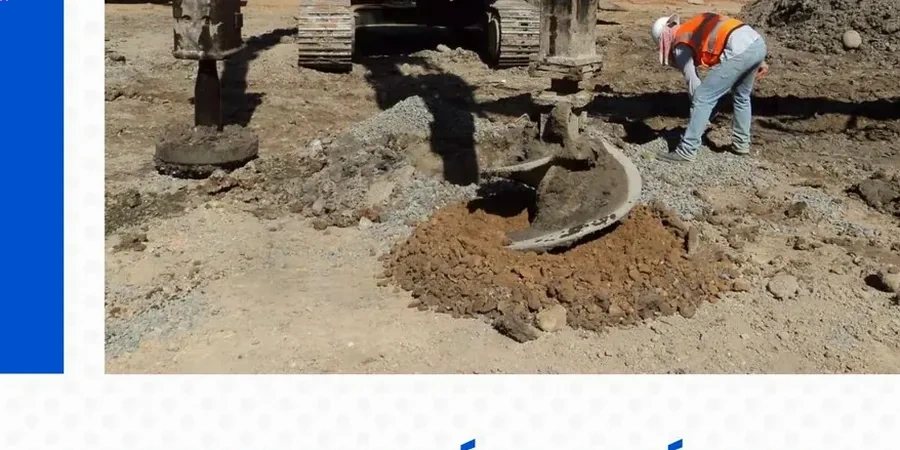
Procedure video
Critical ground factors in Exeter
Exeter's growth since the 1990s pushed light-industrial and residential development into the Exe floodplain and onto former water-meadows that were never engineered for modern structural loads. The problem is hidden — the top metre often looks like firm brown clay, but beneath it sits a layer of soft, organic-rich alluvium that can lose 40 percent of its undrained shear strength when remoulded during excavation. If a contractor proceeds with conventional pad footings without ground treatment, differential settlement between the naturally stiffer terrace gravels and the treated zone can crack blockwork within the first two years. The insurance claims data from NHBC highlights poor ground as a factor in over half of foundation-related defects in the South West. Stone column design directly addresses this by creating a homogenised, drained composite mass that reduces total settlement and, critically, equalises differential movement across the footprint. The design must also account for the seasonal groundwater fluctuation in the Exe corridor — the column aggregate needs to be clean, angular crushed rock with less than 5 percent fines so that drainage function is maintained even when the water table rises to within 1 metre of finished floor level during winter months.
Our services
Our involvement on Exeter projects typically starts during the feasibility stage, because the decision between piling and stone columns affects the entire structural grid and drainage strategy. We deliver three core service packages that cover the full design-to-verification sequence.
Feasibility assessment & ground investigation scoping
Review of existing borehole logs and walkover survey to map the soft alluvium extent; specification of supplementary CPT soundings at column locations to confirm refusal depth and lateral variability across the site.
Detailed stone column design package
Priebe-method calculations calibrated with site-specific modulus data, producing column grid layout, diameter, depth schedule, aggregate specification, and settlement prediction curves for the design bearing pressure.
Installation supervision & verification testing
Full-time supervision during vibroflot installation with real-time depth and amperage logging, followed by zone load testing on sacrificial columns and a plate load test programme on the production grid per BS EN 1997-1 requirements.
Common questions
What does stone column design and installation typically cost for an Exeter site?
For a commercial or industrial footprint in the Exeter area with up to 6 metres of soft ground, the combined design, mobilisation, installation and testing package generally falls between £1,270 and £4,210 per column group, depending on depth, aggregate specification, access constraints and the extent of verification testing required. A mid-sized warehouse pad with 80 to 120 columns often lands in the £2,500–£3,200 per-column range once mobilisation is amortised.
How do you decide between stone columns and driven piles in Exeter's ground?
The decision hinges on the depth to competent rock. Across most of the Exe Valley, the Dawlish Sandstone lies within 6 to 8 metres of ground level, which is inside the economic range for stone columns. If the soft cover exceeds 9 metres or the bedrock is too weathered to provide reliable end-bearing, driven or CFA piling becomes more cost-effective. We run a comparative settlement and cost model for both options using CPT data from the specific site so the client can make the call on solid numbers.
How long does the treated ground take to consolidate before construction can start?
One of the main advantages of stone columns in Exeter's silty alluvium is the accelerated drainage path. The columns act as vertical drains, reducing the radial drainage distance to half the column spacing. For a typical grid at 2-metre centres in material with a coefficient of consolidation around 2–5 m²/year, 80 to 90 percent of primary consolidation is complete within two to four weeks. We confirm the timeline with pore pressure dissipation data from the CPTu soundings used during the ground investigation phase.