Exeter's building stock spans from Roman foundations beneath the cathedral close to the new housing estates pushing into the Permian sandstone ridges east of the M5. The city sits on a complex transition zone where the Dawlish Sandstone meets the Exeter Volcanic Series, creating abrupt changes in bearing capacity and shear behaviour over distances of less than 100 metres. A developer who assumes uniform ground conditions across a site near the Exe floodplain is gambling with the structural integrity of their project. The triaxial shear test removes that uncertainty by quantifying how the ground will fail under load. For deeper sites where sandstone bedrock is variable, we combine triaxial data with SPT drilling to map refusal depth and weathered zones, and when near-surface lenses of softer alluvium are suspected a CPT campaign provides continuous profiling before undisturbed sampling for the triaxial cell.
Exeter's Permian geology gives drained friction angles anywhere from 28° in weathered mudstone to 42° in clean sandstone — a 14-degree spread that makes or breaks foundation economics.
Scope of work in Exeter
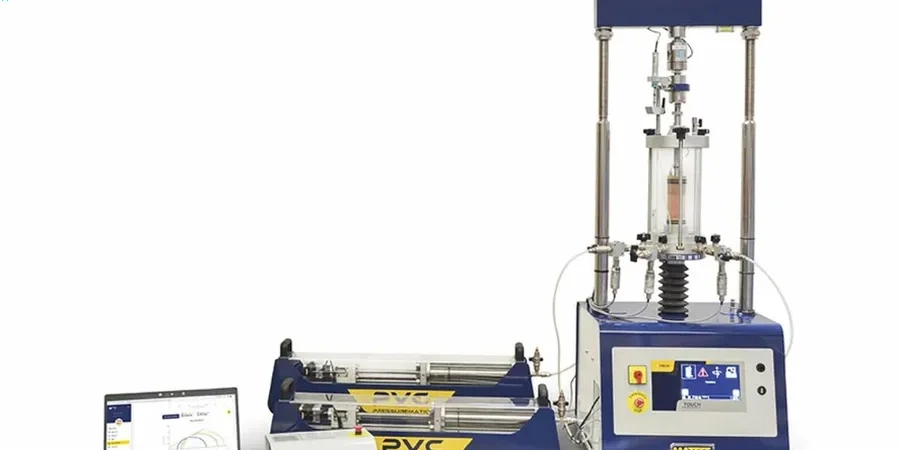
Procedure video
Critical ground factors in Exeter
A recurring mistake we see on Exeter construction sites is the use of quick undrained triaxial tests on silty sand from the Exe Valley without checking whether the material was fully saturated. Partially saturated specimens produce a false cohesion intercept of 15–25 kPa that disappears the moment the ground becomes saturated during a wet winter. The designer then specifies a shallower foundation or a steeper cut slope based on phantom strength that simply does not exist in the field. When the Exe rises — which it does reliably between November and February — pore pressures equalise and the apparent cohesion vanishes, triggering settlement or slope movement. The correct procedure under BS 5930 is to measure Skempton's B parameter before shearing. If B is below 0.95, the specimen needs additional back-pressure saturation. Skipping this step to save three days on a programme has led to retaining wall failures in St Thomas and cracks in blockwork on a student accommodation project near the university campus. For basement excavations in the city centre conservation area, we recommend pairing triaxial strength data with excavation monitoring during construction to verify that in-situ behaviour matches the laboratory curve.
Our services
Our triaxial testing programme for Exeter projects covers the full range of shear strength conditions encountered across the city's geology, from the strong Dartmoor-derived granites to the weak Mercia Mudstone in the east.
Consolidated Undrained (CU) with pore pressure measurement
The standard test for Exeter's low-permeability Aylesbeare Mudstone and volcanic clay. We measure pore pressure throughout shear using a mid-plane probe, giving effective stress parameters c' and φ' for long-term slope and foundation design.
Consolidated Drained (CD) for granular and stiff materials
Applied to the Dawlish Sandstone and weathered breccia where permeability allows full drainage during shear. The slow strain rate yields the true drained friction angle, critical for open cuts and retaining wall backfill analysis.
Multi-stage triaxial on a single specimen
Cost-effective for sites with limited undisturbed sample recovery. One specimen is sheared in three successive stages at increasing confining pressure, producing a complete Mohr-Coulomb envelope from a single 100 mm tube sample.
Common questions
How much does a triaxial test programme cost for an Exeter project?
A standard set of three CU triaxial tests on 100 mm specimens, including saturation, consolidation and shear with pore pressure measurement, falls between £1,460 and £1,930 depending on whether drained stages are required and how many days of shearing the material demands. Multi-stage tests on a single specimen reduce the per-envelope cost if sample recovery is tight.
How long does a drained triaxial test take on Devon soils?
For Exeter's stiff clays and mudstones, a drained test typically requires four to five working days per specimen at the correct strain rate. Sandy soils from the Dawlish Sandstone can drain in 24–36 hours. We always calculate the time-to-failure from consolidation data — BS 5930 specifies that the strain rate must prevent excess pore pressure exceeding 5% of the applied deviator stress.
What is the difference between effective stress and total stress parameters, and which do I need?
Effective stress parameters c' and φ' govern long-term stability: they are what the ground 'feels' once excess pore pressures have dissipated over months or years. Total stress parameters cu and φu are short-term, undrained values relevant during construction. For most Exeter permanent works — foundations, retaining walls, embankments — you need effective stress parameters from a CU or CD test with pore pressure measurement. Total stress from UU testing is mainly used for temporary works and staged excavation analysis.