Exeter's geology is a proper puzzle. The city sits on Permian sandstone and breccia, but the real headache is the Dawlish Sandstone Formation running right underneath the centre. You start digging past three metres and the water table changes the whole game, especially near the River Exe floodplain. That's why geotechnical excavation monitoring in Exeter isn't a box-ticking exercise. It's continuous risk management. Before shoring goes in, we map the pre-existing crack patterns and install baseline markers. The data feeds into a live dashboard that flags any lateral displacement above 2 mm, giving site managers the window they need to adjust propping before the morning briefing. For deeper schemes near the Exe Bridges area, we often pair monitoring with a CPT survey to correlate pore pressure profiles with real-time deformation readings, keeping the excavation support design grounded in actual subsurface behaviour, not just desktop assumptions.
Monitoring isn't about measuring what already shifted. It's about catching the trend before the crack opens.
Scope of work in Exeter
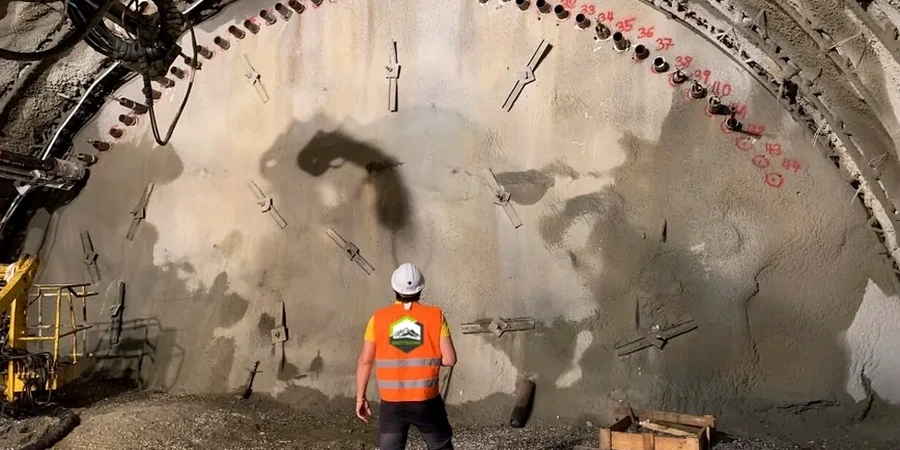
Procedure video
Critical ground factors in Exeter
BS EN 1997-1:2004 (Eurocode 7) Section 7 is crystal clear: the design of earthworks and retaining structures must be verified by monitoring whenever the ground conditions are variable or the consequences of failure are severe. Exeter ticks both boxes. The transition from breccia to alluvial clay happens over just a few metres in the city centre, creating differential stiffness that loads one strut while the next one sits idle. If you're not collecting load cell data and comparing it against the geotechnical interpretive report, you're effectively flying blind. Worse, the Environment Agency takes a dim view of excavation collapses that mobilise silt into the Exe. A single failure can trigger a pollution incident investigation alongside the HSE visit. Our monitoring plans map every instrument to a specific design assumption, so if the ground doesn't behave as the model predicted, the evidence is timestamped and the remediation decision is defensible.
Our services
Every excavation monitoring package we deliver in Exeter is built around the specific geometry of the dig and the adjacent structures at risk. No two sites get the same instrument list.
Deep Excavation Monitoring Package
Includes automated total station arrays, inclinometer casings behind the retaining wall, vibrating wire piezometers at two depths, and load cells on every level of propping. All data streams into a single live dashboard accessible by the site team, the designer and the client. Weekly summary reports highlight trends and flag any parameter approaching its trigger value.
Basement Dig Monitoring and Trigger Review
Designed for Exeter's city-centre commercial and residential basement schemes. Combines surface settlement markers along the pavement, crack monitors on adjacent masonry party walls, and manual tape extensometer readings across the excavation. We chair a fortnightly trigger review meeting with the temporary works coordinator to calibrate alert thresholds as the dig progresses through different strata.
Common questions
How much does excavation monitoring cost for a typical Exeter basement project?
For a single-level basement dig with four sides of retaining wall and one level of propping, monitoring typically falls between £720 and £2,250 depending on the number of instruments, reporting frequency and duration. A package covering inclinometers, load cells, piezometers and automated prism tracking over a 12-week bulk dig is usually at the upper end of that range. We provide a fixed-price proposal once we've reviewed the temporary works drawings and the ground investigation report.
What instruments are essential for monitoring a deep dig in Exeter's sandstone?
At minimum, you need inclinometers to track lateral deflection behind the wall, load cells to verify strut forces match the design assumptions, and piezometers to monitor pore water pressure changes as you dewater. In Exeter's Dawlish Sandstone, we also recommend crack monitors on adjacent historic structures, because the sandstone weathers differentially and movement can transfer to party walls before it shows up in the inclinometer data.
Do you install the monitoring equipment or just read it?
We handle the full chain: supply, installation, commissioning, baseline readings, continuous monitoring and final close-out report. Our technicians install inclinometer casings in boreholes, weld load cells onto steel struts, drill piezometers into the formation and set up automated total stations with fixed reference prisms. Everything is calibrated on site against known benchmarks before the dig starts.
How quickly can you mobilise if the excavation is already underway and we've spotted movement?
We can have a technician on site within 24 hours in Exeter. The priority is to install check prisms on the affected wall face, take manual convergence readings across the excavation, and review any existing movement data. Within 48 hours we'll have a basic automated monitoring loop running. If the situation is critical, we'll issue an interim trigger review the same day to advise the site team on safe working limits while the instruments are bedding in.