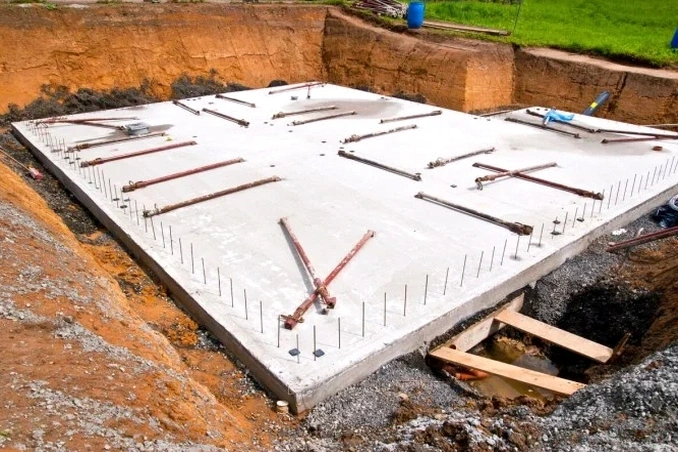
Exeter’s expansion from its Roman walls onto the steep Permian hillsides created a patchwork of foundation challenges that still define construction here. The red breccia and sandstone weather unpredictably. Clay bands swell and shrink with the seasons. Groundwater follows ancient buried channels. A standard strip footing often runs into trouble within the first two metres. Raft/mat foundation design shifts the load path across a larger bearing area, bridging soft spots and reducing differential settlement. When we investigate a site near the Exe floodplain or up around Pennsylvania, we look at more than bearing capacity. We map the stiffness profile, seasonal moisture variation, and how the raft will interact with a ground profile that can change across the width of a single plot. A well-designed raft turns a marginal site into a straightforward build.
In Exeter’s mixed Permian ground, a raft foundation isn’t just a slab—it’s a structural bridge over the unknowns beneath the site.
Scope of work in Exeter
Critical ground factors in Exeter
St Leonards and Heavitree sit on the same Permian sandstone, but foundation behaviour is nothing alike. St Leonards, higher up and well-drained, sees stiff competent ground within a metre. Heavitree, lower and crossed by buried stream valleys, hits soft saturated clay bands that compress under load. We’ve seen projects where a raft designed for St Leonards conditions was proposed unchanged for a Heavitree site—and the differential settlement prediction tripled. The risk isn’t total collapse. It’s cracking in the superstructure, binding doors, and remedial costs that dwarf the original foundation budget. A site-specific raft/mat foundation design, informed by at least three boreholes and seasonal groundwater monitoring, eliminates that gamble. The difference in build cost between a thickened-edge raft and a heavily reinforced stiffened raft with deep downstand beams can be £15,000 on a typical detached house. Getting the classification wrong costs far more.
Our services
Our raft/mat foundation design work in Exeter covers the full project lifecycle, from desk study through to construction support. Each service is tailored to the local ground profile and the specific demands of the structure.
Geotechnical Interpretative Report
We compile ground investigation data into a design-focused report that defines the ground model, design parameters, and geotechnical risks specific to your Exeter site. This is the foundation document for any raft design.
Raft Foundation Design & Detailing
Full structural-geotechnical design of flat, wide-toe, or cellular rafts. We deliver bending moment envelopes, reinforcement schedules, and a construction specification aligned with BS EN 1992 and BS EN 1997.
Soil-Structure Interaction Analysis
Using calibrated Winkler spring models or finite element analysis, we assess how the raft and the ground deform together. This is essential on Exeter’s variable profiles where a rigid-plate assumption is unsafe.
Construction Phase Support
We review subgrade conditions at excavation level, confirm bearing stratum compliance, and advise on any last-minute design adjustments. On-site presence keeps the design intent intact through to the pour.
Common questions
How much does a raft foundation design cost for a project in Exeter?
For a typical residential or light commercial project in Exeter, our fee for the geotechnical investigation and raft/mat foundation design package ranges from £890 to £3,320, depending on the structural complexity, number of boreholes required, and whether seasonal groundwater monitoring is needed. Complex cellular rafts or sites in the floodplain fall at the higher end.
When is a raft foundation better than strip footings in Exeter?
Rafts become the better choice when the bearing stratum is deeper than 1.5–2.0 metres, when the ground contains soft or variable zones that would cause differential settlement under isolated footings, or when the groundwater table is high. Exeter’s Permian mudstones and alluvial valleys often trigger these conditions.
What ground investigation is needed before designing a raft foundation?
We specify a minimum of three boreholes or trial pits for a typical residential raft, extending to at least 3 metres below proposed formation level. In Exeter we also recommend seasonal groundwater standpipe monitoring, particularly for sites within 500 metres of the River Exe or its tributaries, to capture winter high levels for buoyancy checks.
Do you handle both the geotechnical and structural design of the raft?
Yes. We deliver the complete package: from ground investigation specification and interpretative reporting through to structural design of the raft, reinforcement detailing, and construction-stage supervision. This integrated approach means the geotechnical assumptions and structural model are consistent throughout the design process. More info.