Exeter sits at the head of the Exe Estuary, where the River Exe cuts through Permian sandstone and deposits a complex sequence of alluvial gravels, sands, and soft silts. Ground investigations around Marsh Barton and the quayside regularly encounter loose granular fills up to 5 metres thick, a legacy of the city's Roman and medieval waterfront development. Building on these deposits without treatment invites unacceptable differential settlement. Our approach to vibrocompaction design addresses this directly: we specify vibrator type, grid spacing, and energy input based on the fines content and grain-size distribution of the native material, not a generic chart. A CPT test programme executed before and after treatment provides measurable verification that target relative density has been achieved, giving the structural engineer a reliable bearing stratum for shallow footings or ground-bearing slabs.
BS EN 14731:2005 defines the execution standard — our designs deliver a relative density above 70% verified by CPT before a single foundation is poured.
Scope of work in Exeter
Critical ground factors in Exeter
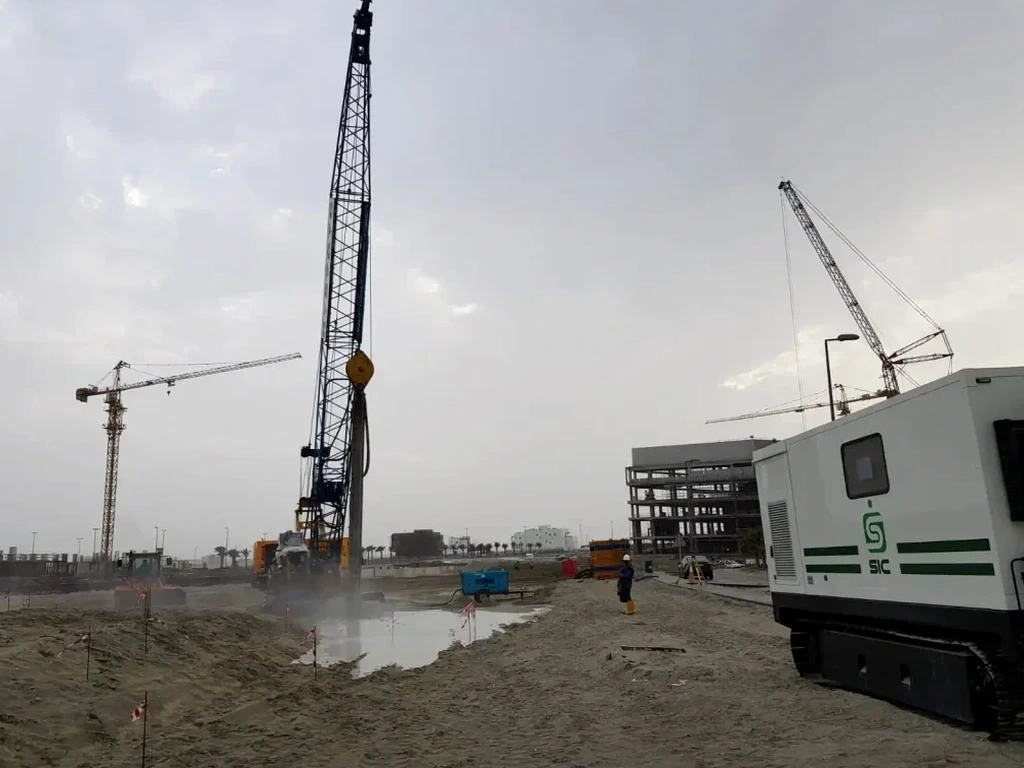
A six-storey residential frame on the former Exeter gasworks site encountered 8 metres of uncompacted demolition rubble overlying loose River Exe gravels. Standard dynamic compaction was ruled out due to proximity of a Victorian sewer and a Network Rail viaduct within 30 metres. The alternative — a piled raft — would have added £400,000 to the substructure cost and delayed the programme by fourteen weeks. Vibrocompaction with a bottom-feed electric vibrator on a 2.2-metre triangular grid achieved 72% relative density across the full treatment depth, confirmed by five post-treatment CPT soundings. Vibration levels at the viaduct pier never exceeded 3.2 mm/s. The risk of bypassing a proper ground improvement design is not theoretical in Exeter: loose granular soils beneath the water table can densify suddenly under cyclic loading, producing settlements that crack masonry and shear buried services. A treatment specification developed without site-specific calibration — or without verification testing — leaves the project exposed to exactly this failure mode.
Our services
Our vibrocompaction design package for Exeter projects spans the full sequence from feasibility assessment through to post-treatment sign-off. Each commission is supervised by a chartered geotechnical engineer familiar with the local Mercia Mudstone and Exeter Group sandstone formations.
Trial compaction and grid calibration
We design and supervise a trial array on site to establish the optimum probe spacing, dwell time, and energy input for the specific soil profile. Results feed directly into production specifications.
Verification testing and compliance reporting
Post-treatment CPT, PMT, or zone load testing correlated against pre-treatment baselines. We deliver a compliance statement confirming target relative density and bearing capacity per Eurocode 7 requirements.
Common questions
What is the cost range for a vibrocompaction design package in Exeter?
For a typical Exeter project treating 400 to 1,500 square metres of loose granular ground, the design package — including pre-treatment CPT soundings, trial array design, production specification, and post-treatment verification — falls between £1,250 and £3,760. Scope, number of verification tests, and site constraints influence the final fee.
How does vibrocompaction perform in the mixed ground conditions found around Exeter?
The city's geology ranges from Permian breccia and sandstone on the ridges to deep alluvial gravels and silts in the Exe Valley. Vibrocompaction works best in granular soils with less than 15% fines; above that threshold we switch to a bottom-feed system or evaluate stone columns as an alternative. Each design is calibrated to the actual gradation curve from site-specific boreholes.
What verification method does Eurocode 7 require after vibrocompaction?
BS EN 1997-1 and the UK National Annex require direct verification of design assumptions. For vibrocompaction, this means pre- and post-treatment in-situ testing — typically CPT soundings at the centroid of compaction triangles — correlated with laboratory grain-size distribution and maximum/minimum density tests. The number of verification points depends on the treated area and the consequence class of the structure.
Can vibrocompaction be used near Exeter's listed and heritage structures?
Yes, provided vibration monitoring is designed into the specification from the start. We set a 5 mm/s peak particle velocity limit at the nearest sensitive structure in accordance with BS 7385-2, and specify probe withdrawal rates and starting distances from the building line that keep measured vibration well below that threshold. Pre-condition surveys of adjacent buildings are standard practice.